

Love the words
An essay from my upcoming book Why Words Matter - and an invitation

I have read hundreds of books about writing.
Most of the time they have kept me from doing what I long for, the very reason I am reading a book on writing, which is to actually write myself.
In my early days as a writer, I gorged on them, imagining there was a secret I was too thick to unearth on my own that would ignite the fires of my own creativity. Like an addict, I would tell myself just one more book. One more writing exercise that begins, ‘I remember…’ One more instructive ‘show don’t tell.’
I am obsessed with the details of other authors’ daily writing rituals. I want to be a dust mote in the space where someone else creates. I long to eavesdrop on the way artists talk to themselves, have X-ray vision into someone’s thoughtful dismantling of the mechanics and magic of their craft. I am a spongey learner, curious about writing problems and what they reveal about how we, as humans think, make meaning, strive and fail at intimacy and communication. For that is what writing is – a relationship, with ourselves and others.
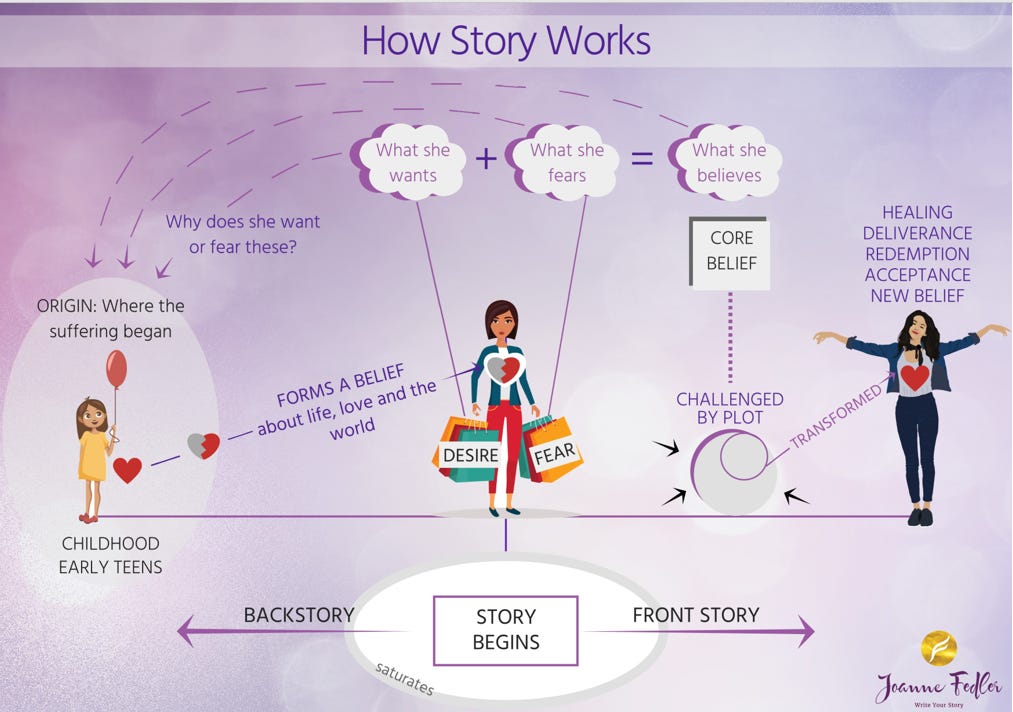
I admire writers who can make the intuitive, explicit, like a machine, taken apart, its components laid bare. I strive to do this, as much to understand my own process, as for my students – to see if I can untangle a piece of writing and break it down into a map or algorithm. I have had varying success with this approach – some of my ‘recipes’ for writing, have, I hope, been helpful to those struggling to parse out the beats of a scene, layer their narrative, or deepen into meaning-making.
But there comes a point when one must take oneself in hand and rebuke the lust-for-another-book, with a stern reality check: that reading is no substitute for doing. Self-help feeds on self-doubt. We can be too readily distracted by promises of iridescent ‘out-there’s’ instead of looking ‘in here.’
If we want to write, there best thing to do is write.
We will never find the deep tug to commit to the process in books written by others.
I used to correspond with a professor of Shakespeare from my university days who passed away a few years ago. He once sent me his red pepper soup recipe. Highlighted in huge red letters were the words: YOU HAVE TO LOVE THE VEGETABLES. He was a connoisseur of language, unwasteful and meticulous, and so I took him literally and proceeded to love those vegetables in a manner I had only ever reserved for animate beings.
It made a difference to the soup.
If we love the words, we will write. To write, we must love the words.
This is where we might fail before we even start, especially if we think there’s a shortcut. Intimacy of any kind is a slow-earned privilege, not a Tinder hook-up.
If we are born with hearing, we’re immersed in language from our first cry (as shouts of It’s a boy! It’s a girl! Mazeltov! fill our newborn ears) and find our way into it by some mysterious neurological osmosis. Without hearing, we have to learn language, like an Inuit might learn Chinese – painstakingly, one letter of the alphabet, one word, one grammatical construction at a time.
We have words, and having them, we don’t think to love them. It’s almost as if we perversely need tragedy to illuminate our appreciation of what is already in and around us, whether it’s sight, companionship, a warm bed at night, the dullest of happinesses. We take for granted what it is we haven’t had to fight for (status, money, health, education). But I am perfectly clear that in my current state, unafflicted by a degenerative neurological condition – I couldn’t love words more.
I studied Linguistics in my first year at university – it was ‘languagey’ and an easy credit while I focused on English literature and Law. I learned that there were invisible embedded structures in sentences, revealing deep roots, layers of broken down parts of speech, geometric and formulaic which accrue towards meaning. I realized I was using language without understanding how it actually ‘works’. Of course I have gaily gone on to make use of microwaves, computers and have even produced two babies from my womb without understanding their operating systems either.
Being able to speak and understood in our language is like inheriting a genetic disposition for say, classical music, or drawing when others need years to learn the art. The talent is bundled into us, complete, awaiting discovery.
Every life has its igniting moments. We are kissed for the first time taking shelter from a storm and can barely hear the pelting rain through the thundering of our heart. A marvellous educator explains a complicated arithmetical problem and we get it. The dawn light strikes Uluru in an orange blaze and tears are all we manage in reply.
When I was fourteen, my father handed me a copy of Dylan Thomas’s play for voices, Under Milk Wood and as I read the opening lines for the first time, that voltage shuddered through me:
‘To begin at the beginning. It is spring, moonless night in the small town, starless and bible-black, the cobblestreets silent and the hunched courters’-and-rabbits wood limping invisibly down to the sloeblack, slow, black, crowblack, fishingboat-bobbing sea.’
I’ve never watched trapeze artists and thought, ‘I wish I could do that.’ Some folks do. They go on to become wonderful acrobats and travel the world in caravans, although in this day and age, probably in airplanes. But when I read Dylan Thomas, I thought to myself, ‘I wish I could do that.’
A phrase like ‘the clip clop of horses on the sunhoneyed cobbles of the humming streets’ was thrilling in my mouth, to my ear. From that moment, I just wanted to be left alone with words, so I could make shapes the way some people build Lego castles.
I have filled more than sixty journals over my lifetime. The tug to understand ‘what just happened there?’ hasn’t yet lost its hold on me. I am summonsed, often, like a doctor on call – to grab a pen and paper or open notes in my iPhone so I can trap a thought or image. I spend hours - days, weeks, months, which have turned into years – making sense of circumstance to discover what is brewing inside me. I don’t understand what people for whom this inner interrogation is not an urgent compulsion mean by ‘my life.’
I never want to be far from words, so when I am not writing, I am reading. Occasionally blog posts and articles. Never Tweets. Books, more likely that have taken someone years to conceive so I can submerge in the deep interstitial layers of story, and discern the beats of a character arc, ride the structure of revelation and marinate in language.
The older I get, the less careless I want to be with sentences. I do not want to flog flaccid, bland, boring, impotent language. I want to keep learning how to ‘set a chime of words tinkling in the minds of people’ to quote Logan Smith.
In Beloved for which she won the 1993 Nobel Prize for Literature, Toni Morrison describes Paul D confronting Sethe with the atrocity of what she’s done. He reprimands her, saying she has two legs, not four. Morrison then writes ‘…and right then, a forest sprang up between them; trackless and quiet.’
Her words are sculptural; they are places I want return to, if only to be stirred again by the soft appreciation of things perfectly said.
The English author, Terry Pratchett describes a dog as ‘halitosis with a wet nose,’ and I literally smell funky dog-breath.
As I align words with meaning, the dials of my thinking are tuning in. When I take time to choose one word over another, differentiating between ‘adore’ and ‘cherish,’ or ‘ hate’ and ‘loathe,’ I am practicing discernment, making subtle decisions. I feel less clumsy in the ways that are important to me because I’m not bludgeoning my way through life with blunt judgements. I’m tiptoeing towards nuance. I’m inclined to back away from the shallows of quick opinion and social media updates. Words bring me closer to the version of myself I like best – the person I am trying always to become. Perhaps even in the next sentence.
Platitudes overreach like nets thrown in the ocean snagging innocent ‘by-catch.’ I don’t want to be wasteful.
Language is an ally when I feel my heart shattering and I weep with despair about what we are losing all around us. I trust that words can, if we are scrupulous with them, help us. They are waiting to be deployed to shape the ways we think and solve crises. Maybe the care we take with language will have a spill-on effect. Maybe they will make us a more careful species.
I became an open water ocean swimmer after a back injury a few years ago. Daily swims turned me from an onlooker who ‘loved’ the ocean, to a committed environmental protector, invested in its health and continuation. Jacques Cousteau wrote, ‘people protect what they love.’ That is only partially true. It assumes we know what we love. We don’t. The Turkish poet Nazim Hikmet explains this hiatus of self-awareness in his poem ‘Things I Didn’t Know I Loved,’ - we don’t know what we love until they are taken from us or until we blindly, blithely destroy it.
When I close my eyes, what swarms before me are words, the tools to which I am bound, to make sense of this life. I want to be accountable to this calling, to offer it back as a howl, a summons, a plea, so I have not wasted my life shuffling them uselessly.
Rumi wrote, ‘let the beauty we love, be what we do.’
And so if love is why we are here, let us praise what can be tenuously salvaged.
In cherishing words, we are loving all things they touch.
***
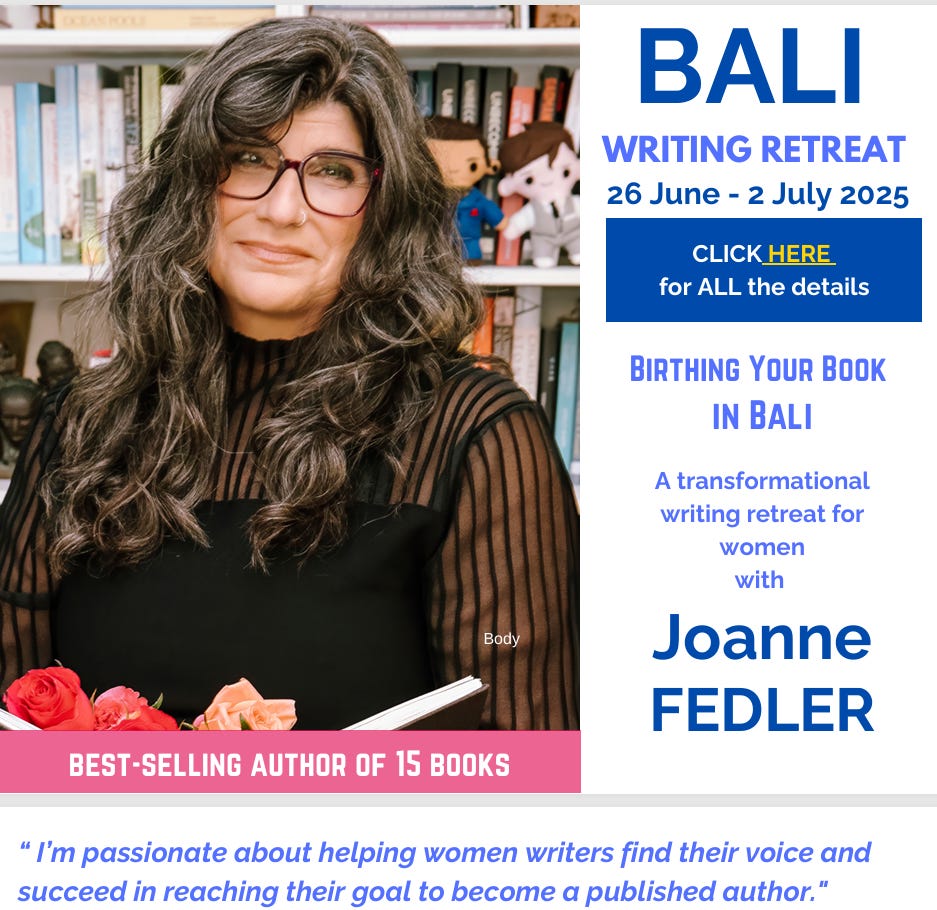
If you would like to spend a week with me, working on loving words, why not join me in Bali.
Oh my god - to say I loved those opening lines from Under Milkwood is an understatement.
They grabbed me and I flew . . .